
- Dongguan Zhuohang Ltd (brand: Zhuohang Precision Machining Factory), founded 2005, Hengli Town, Dongguan, Guangdong, China.
- 6,800 m² facility, 100+ people, 80%+ skilled technicians.
- 100+ production machines and 20+ inspection instruments.
- ISO 9001 + IATF 16949 + ISO 14001, certificate numbers verifiable with the registrar.
Who is behind CNC Prototyping Service?
The name on the invoice is Zhuohang Precision Machining Factory, and the brand is Zhuohang Precision Machining Factory. "CNC Prototyping Service" is the site you landed on — one of several web properties that point to the same physical factory. That matters because you should always be able to reconcile the website name with the legal entity on the order, and a manufacturer that is a single, identifiable company is easier to audit than a network of trading aliases.
Founded in 2005, the company has spent nearly two decades machining metal parts for overseas buyers. We are a build-to-print manufacturer: we machine your design, we do not own or redesign it, and the IATF 16949 scope states that boundary explicitly (product design is excluded under Clause 8.3).
The GD&T angle is not a marketing phrase here — it is the operating premise. A build-to-print shop lives or dies by how accurately it reads the print, because it does not have design authority to fall back on. There is no "we interpreted it this way" when the part fails; there is only the drawing and the part, and the gap between them is measured in microns. That is why the whole factory is organized around reading the feature control frame first and cutting second.
What does the facility look like?
A factory is a number you can check, not a brochure claim. Ours: a 6,800 m² facility in Hengli Town, Dongguan, employing 100+ people of whom 80%+ are skilled technicians. The floor runs the full metal-cutting range — 3-axis (50+), 4-axis (20+), and 5-axis (20+) milling centers, 25+ turning centers, 7+ grinders — plus 20+ inspection instruments including two Hexagon CMMs.
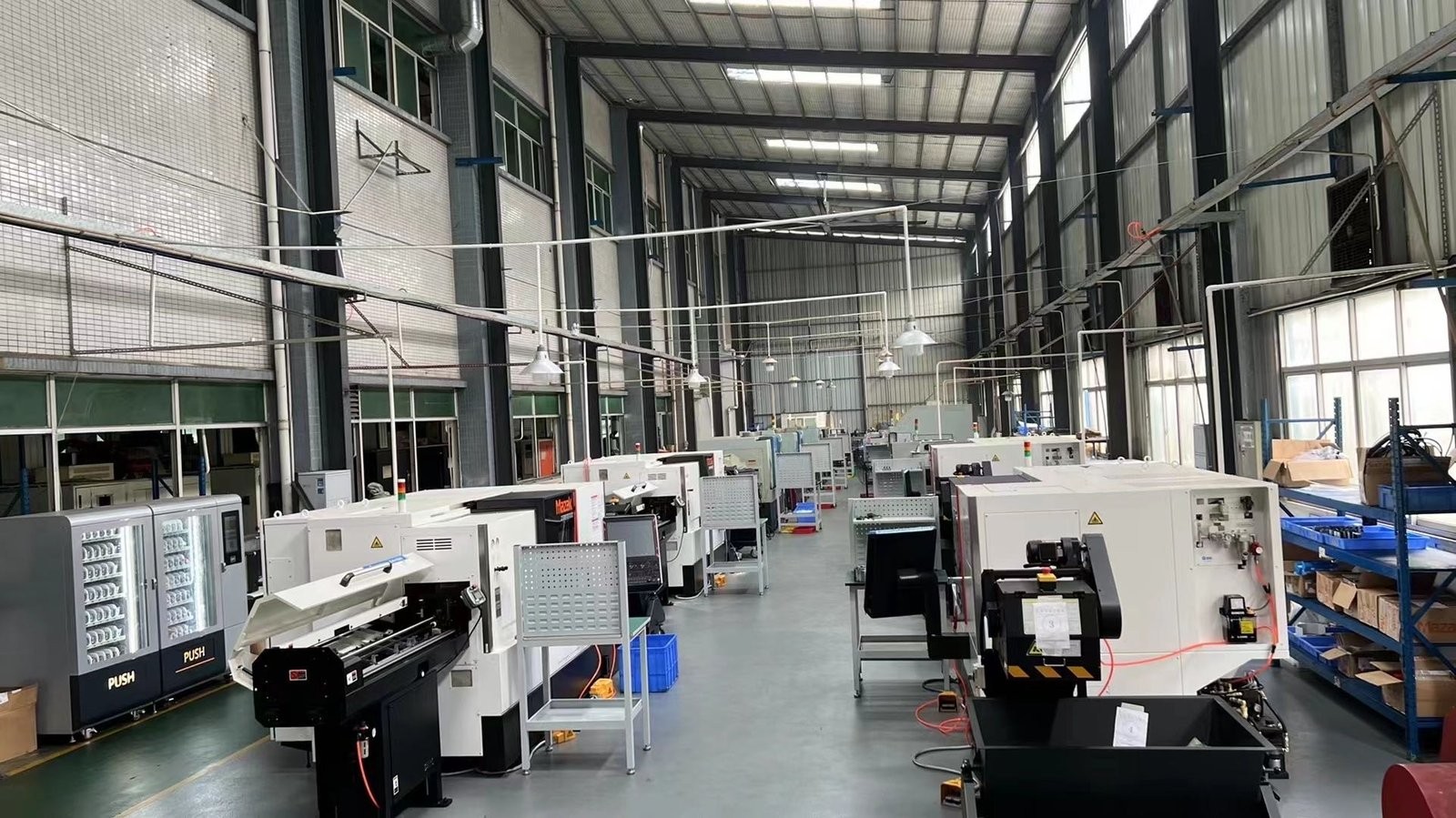
What GD&T capability does the equipment floor support?
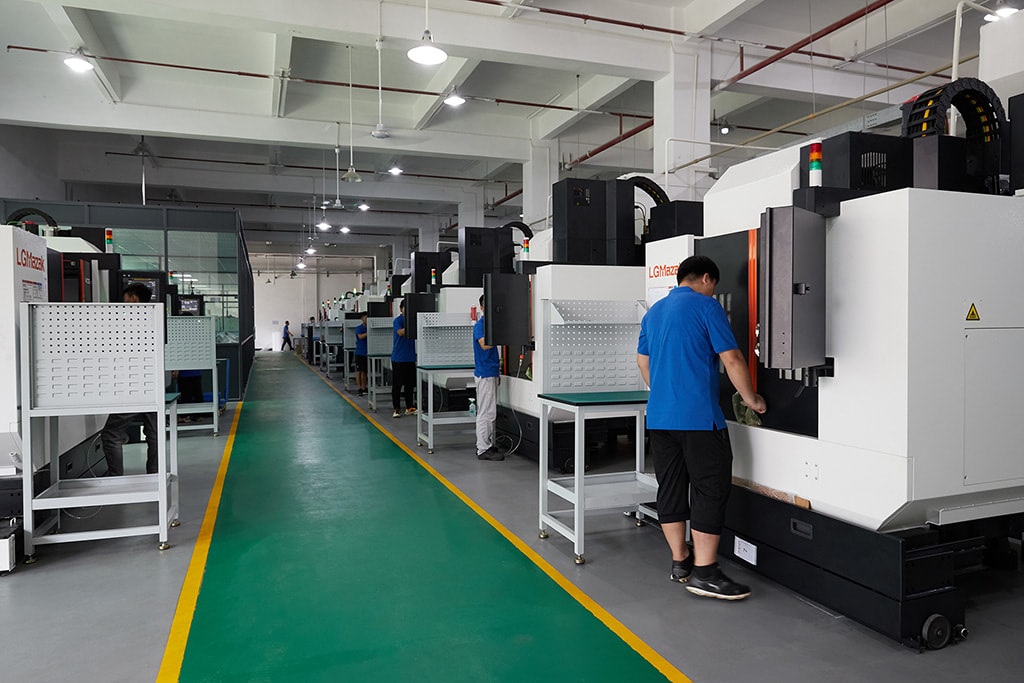

Equipment is where a tolerance claim becomes real or stays a slogan. The floor supports milling and turning to ±0.003 mm (milling) / ±0.002 mm (turning) and grinding to ±0.002 mm, and the axis mix is what holds your geometric callouts:
- 5-axis centers hold true position across compound angles in a single setup, so no tolerance is spent re-fixturing.
- Mill-turn centers turn and mill a bore and its surrounding features in one clamping, keeping them concentric.
- Grinding finishes the tightest roundness and cylindricity bands on hardened parts.
Two Hexagon GLOBAL S CMMs then verify those characteristics against their datums, reporting measured values rather than pass/fail flags.
The equipment list is not a brag; it is the answer to a specific question. A position callout across two angled faces needs a 5-axis center, a runout callout needs a lathe with a stable axis, a tight cylindricity on a hardened bore needs a grinder. The mix exists so that the process can be matched to the callout instead of forcing every part through one machine and hoping. That is what "GD&T-literate" means at the floor level — the machine is chosen from the feature control frame.
What certifications does the factory hold?
Three certificates, each with a number you can verify with the registrar (URS). The numbers matter more than the logos — a real certificate can be checked.
| Standard | Certificate number | Scope |
|---|---|---|
| ISO 9001:2015 | 116024/A/0001/UK/En | Machining of metal parts |
| IATF 16949:2016 | 131941/A/0001/SM/En | Manufacture of CNC metal machining parts (excludes product design, Clause 8.3) |
| ISO 14001:2015 | 116024/B/0001/UK/En | Environmental management related to machining of metal parts |
What the certificates actually buy you are process discipline, not a logo on a wall. ISO 9001 means the quality system is documented and audited. IATF 16949 means the process control — FMEA, PPAP, SPC, traceability — reaches the bar automotive buyers require. ISO 14001 means the environmental side is managed, which matters increasingly for European buyers with supply-chain reporting obligations. The scope note on IATF is stated honestly: we do not own product design, and we do not pretend to.
What runs in-house versus outsourced?
Honesty about outsourcing is a trust signal, not a weakness — every manufacturer outsources something, and the ones worth buying from tell you which parts. Here is our boundary:
| In-house | Through qualified partners |
|---|---|
| CNC milling, turning, mill-turn, grinding, deburring, tapping, laser marking | Anodizing (standard and hard), plating, powder coating, painting |
| Low-temperature heat treatment (in-house ovens to 500 °C) | Vacuum heat treatment, carburizing, nitriding, and titanium stress relief above 500 °C |
In-house ovens reach 500 °C, which covers aluminum aging and low-temperature steel stress relief. Titanium stress relief requires roughly 788 °C and is outsourced to a qualified partner — stated here rather than hidden, because you deserves to know exactly who owns each step.
Why this matters for a GD&T part: every outsourced step is a place where a dimension can move. Anodizing adds a controlled thickness that changes a bore's size; heat treatment can distort a part and shift its form. A shop that knows which steps leave the building — and compensates for them in the machining allowance — is the shop that delivers the finish and the tolerance together. A shop that hides its outsourcing is gambling with your final dimension.
How does the factory protect your IP and drawings?
Your drawing is the most valuable thing you send. Our handling is deliberate: sensitive paper files are stored in a secure, smart-locked space, and digital data is held on encrypted drives. Drawings, models, and customer data are used only for the job they were supplied for, and the company code of conduct binds confidentiality, data protection, and intellectual-property handling.
For a build-to-print shop, IP discipline is also a technical discipline. The drawing and the CAM program are the only record of what you approved, and they must stay paired through production. A shop that loses the thread between the print and the program is the shop that quietly ships a part that differs from the one you qualified. Confidentiality and version control are the same muscle: both are about keeping the record of your part exactly as you specified it.
How do you audit or visit the factory?
The fastest way to confirm a manufacturer is real is to see it. Factory visits and audits are welcome — walk the floor, read the machine nameplates, and check the inspection bench against what this page claims. A supplier that welcomes that is behaving like a manufacturer; one that deflects is not.
To arrange a visit or request the current certificate copies, contact Felipe Iglesias at [email protected].
What machine brands run on the floor, and why does it matter?
A machine list without brands is a rumor. Our floor runs Mazak, Brother, and TSUGAMI machining centers, with Sodick for precision work. The brands matter for one reason: they are checkable. If you visit, you can walk up to a nameplate and confirm the model, and a named machine park is a sign the shop has made a real capital commitment to holding tolerance, because machine rigidity and spindle thermal stability are the physical foundation every tolerance claim stands on.
Brand is not the whole story, of course. A well-maintained mid-range machine out-performs a neglected premium one, and the CMM verification at the end matters more than the badge on the spindle. But a shop that will not name its machines is asking you to trust a count instead of a fact, and on a tight GD&T part that is the wrong kind of trust.
How is the engineering team organized around GD&T?
The machine is only as good as the person reading the print in front of it. The engineering team is structured so that a drawing is interpreted before it is cut, not discovered mid-job:
- Drawing review first. Every print is read against its datums, feature control frames, and material condition modifiers before it reaches the floor.
- Process mapping. Each callout is mapped to the machine and the inspection method that holds it, and the mapping is stated in the quote.
- DFM feedback. A characteristic the equipment cannot reliably hold is flagged up front, with the reason and the alternative.
- Inspection as a mirror. The same team that sets the datum alignment programs the CMM, so the measurement matches the interpretation.
This is the part of the factory a buyer never sees but always pays for. The difference between a shop that has an engineering review and one that loads a file and presses go is the difference between a first article that passes and a first article that starts an email chain. When you ask a shop to "read back your feature control frames," the answer comes from this team, or it does not come at all.
How does the factory floor move a prototype through its steps?
A prototype is a sequence of controlled steps, not a single cut. The flow is set by the print: the part is reviewed, the process is selected, the program is written, the first piece is cut, and the first piece is measured against its datums before anything else is released. Only when the first article matches the drawing does the rest of the order run, and the first-article report becomes the baseline the production run is inspected against.
The value of this order is that problems are caught at step one, not step one hundred. A datum misread on the first piece is a five-minute correction; the same misread discovered at volume is a rework order. A factory organized this way treats the prototype as the place where the interpretation is proven correct, which is exactly what a prototype is for.
Where is the factory, and how does location shape shipping and support?
The factory sits in Hengli Town, Dongguan, Guangdong — in the Pearl River Delta, the densest precision-machining region in China. The address is No. 8, Shuibian Songyuan Road, Hengli Town, Dongguan, Guangdong, China 523470. For you, that location means two practical things: the supply chain for raw material, tooling, and finishing partners is minutes away, and the export infrastructure for air and sea freight is mature. We ship to Austria, Belgium, the Czech Republic, Denmark, France, Germany, Greece, Hungary, Ireland, Italy, the Netherlands, Spain, Sweden and the United Kingdom in Europe; Brazil, Canada, Mexico and the United States in the Americas; China, Israel, Japan, Singapore and Sri Lanka in Asia; Australia and New Zealand in Oceania; and South Africa in Africa, with English, Portuguese, Spanish, French, and Chinese support available from the sales contact.
Location also matters for the GD&T story. A tight tolerance is easier to hold when the raw material is verified on arrival, the tooling is replaced without delay, and the finishing partner is a short drive from the shop floor. Geography is not a guarantee of precision — equipment and discipline are — but it removes the friction that quietly eats both time and tolerance.
What questions should a buyer ask before committing a drawing?
This page is an invitation to audit, and the questions below are the ones we would ask of any factory — including our own. Run them before you commit a print, and the answers will tell you whether you are talking to a manufacturer or a middleman.
- Who is the legal entity on the invoice? A real factory is one company you can look up.
- What machines, by brand and count, run the floor? A named list is checkable; an anonymous count is not.
- Can they read back your tightest feature control frame? The answer should be in the standard's vocabulary.
- Will they show a measured-value dimensional report? Numbers, not pass/fail stamps.
- Which steps leave the building, and who owns them? Outsourcing should be stated, not hidden.
What this shop actually runs
If you ask for capability evidence, you deserve a specific answer. This facility operates 100+ CNC machines across 6,800 m2 in Dongguan, China, staffed by 100+ people. The machines, listed by category:
- 5-axis machining centres (10+) - Mazak VARIAXIS I-600 (510/910/510 mm travel, 12,000 rpm, 22 kW, 71.6 N·m, 30-tool BT40) and Mazak INTEGREX I-250H S (B-axis 0.0001°, 24 kW, 124 N·m, 38-tool HSK-A63). Applied to compound-angle parts, single-setup multi-face prismatic work, and aerospace fittings where datum transfer loss is unacceptable.
- 3-axis / 4-axis machining centres (50+) - Brother SPEEDIO S500Z2N / S700Z2N (10,000 rpm, 14/21-tool ATC, 0.7 s tool-to-tool, Z-axis 2.2 G) and Mazak VCE-430A L / VCE-570C L (10,000 rpm, 118 N·m, 24-tool ATC). Applied to prismatic parts, plates, brackets, housings.
- Swiss-type turning centres (10+) - Citizen Cincom A20-3F7 (Φ20 mm, 10,000 rpm), TSUGAMI B0206-III / B0205-III (Φ20 mm, 0.1 µm), STAR SR-32JII / SR-32J Type N (Φ32 mm, 8,000 rpm). Applied to long, slender rotational parts at ±0.002 mm.
- CNC turning centres (20+) - HEADMAN T70M/1250 (720 mm swing, 117 mm bore, 3,000 rpm, BMT75 12-station turret). Applied to shafts, bushings, flanges up to ±0.002 mm.
- Wire EDM (5+) - Sodick AQ535L (550/350/300 mm travel, ±20° taper, 800 kg workpiece). Applied to hardened tool steel, internal splines, sharp internal corners that milling cannot reach.
- Inspection: Hexagon CMM + 20+ gauges - Hexagon CMM for coordinate measurement, plus vision system, profilometer, hardness tester, coating thickness gauge, XRF for material verification. The 10:1 rule (gauge 10x more accurate than the band) is applied to every feature.
- Machine highlights - VARIAXIS I-600: one-setup multi-face 5-axis + MAZA-CHECK auto-calibration; INTEGREX I-250H S: DONE-IN-ONE mill-turn, B-axis 0.0001° + Ai thermal shield; SPEEDIO S500Z2N / S700Z2N: Z-axis 2.2 G + 0.7 s ATC; Swiss-type: guide-bush switchable + 0.1 µm resolution.
Tolerance bands: ±0.003 mm milled, ±0.002 mm turned, ±0.002 mm ground or wire-cut. Capability indices: Ppk >= 1.67 at the initial study; Cpk >= 1.33 ongoing in production.
Certifications: ISO 9001:2015 (116024/A/0001/UK/En) · IATF 16949:2016 (131941/A/0001/SM/En, design clause 8.3 excluded) · ISO 14001:2015 (116024/B/0001/UK/En), held by Dongguan Zhuohang Ltd (USCC 91441900MA4UWT6X39, since 2005).
Service area: we supply Austria, Belgium, the Czech Republic, Denmark, France, Germany, Greece, Hungary, Ireland, Italy, the Netherlands, Spain, Sweden and the United Kingdom in Europe; Brazil, Canada, Mexico and the United States in the Americas; China, Israel, Japan, Singapore and Sri Lanka in Asia; Australia and New Zealand in Oceania; and South Africa in Africa, with worldwide delivery from China.
Contact: Felipe Iglesias, [email protected], +86 13126536955.
Audit the factory behind the name.
Email [email protected] or call +86 13126536955 to request certificate copies or arrange a visit.
Frequently Asked Questions
Who is behind CNC Prototyping Service?
In short, CNC Prototyping Service is the web-facing name of Dongguan Zhuohang Ltd, operating under the Zhuohang Precision Machining Factory brand. The company was founded in 2005 and manufactures from a facility in Hengli Town, Dongguan, Guangdong, China — a build-to-print manufacturer, not a trading desk.
How large is the factory?
The facility covers 6,800 m² and employs 100+ people, of whom 80%+ are skilled technicians. It houses 100+ production machines — 3-axis (50+), 4-axis (20+), 5-axis (20+), 25+ lathes, and 7+ grinders — plus 20+ inspection instruments.
What GD&T capability does the equipment floor support?
In short, Milling and turning to ±0.003 mm (milling) / ±0.002 mm (turning) and grinding to ±0.002 mm, with 5-axis and mill-turn centers holding true position across compound angles in a single setup. Two Hexagon CMMs verify the geometric characteristics against their datums.
What certifications does the factory hold?
ISO 9001:2015 (No. 116024/A/0001/UK/En), IATF 16949:2016 (No. 131941/A/0001/SM/En), and ISO 14001:2015 (No. 116024/B/0001/UK/En). The IATF 16949 scope covers manufacture of CNC metal machining parts and excludes product design under Clause 8.3.
What runs in-house versus outsourced?
In short, Milling, turning, mill-turn, grinding, and deburring run in-house. Surface finishing (anodizing, plating, powder coating) and some heat treatment are completed through qualified partners.
How does the factory protect customer IP and drawings?
In short, Sensitive paper files are stored in a secure, smart-locked space, and digital data is held on encrypted drives. Drawings, models, and customer data are used only for the job they were supplied for, in line with the company code of conduct and confidentiality policy.
Can I audit or visit the factory?
Yes. Factory visits and audits are welcome — seeing the machine list and inspection bench in person is the fastest way to confirm a manufacturer is real. Contact [email protected] to arrange a visit.
What machine brands run on the floor?
The floor runs Mazak, Brother, and TSUGAMI machining centers, with Sodick for precision work. Named machine brands matter because you can verify the nameplates in person — an anonymous "over a hundred machines" claim cannot be checked the same way.
How does the engineering team check GD&T before machining?
In short, Each drawing is reviewed against its datums, feature control frames, and material condition modifiers before it reaches the floor. The team maps every callout to the machine and inspection method that holds it, and flags any characteristic the equipment cannot reliably deliver.
Continue reading: CNC Prototyping Services · CNC Prototyping Service · CNC Prototyping Service Parts Manufacturer
Standards referenced on this page
- ASTM B348/B348M-21 — Standard Specification for Titanium and Titanium Alloy Bars and Billets
- ISO 14001 — Environmental management systems — Requirements with guidance for use
- ASTM A582/A582M-12 — Standard Specification for Free-Machining Stainless Steel Bars